

René Girard
Theorist of Mimetic Desire
René Girard (1923–2015) was a French scholar and literary critic who became one of the most original thinkers of the 20th century.
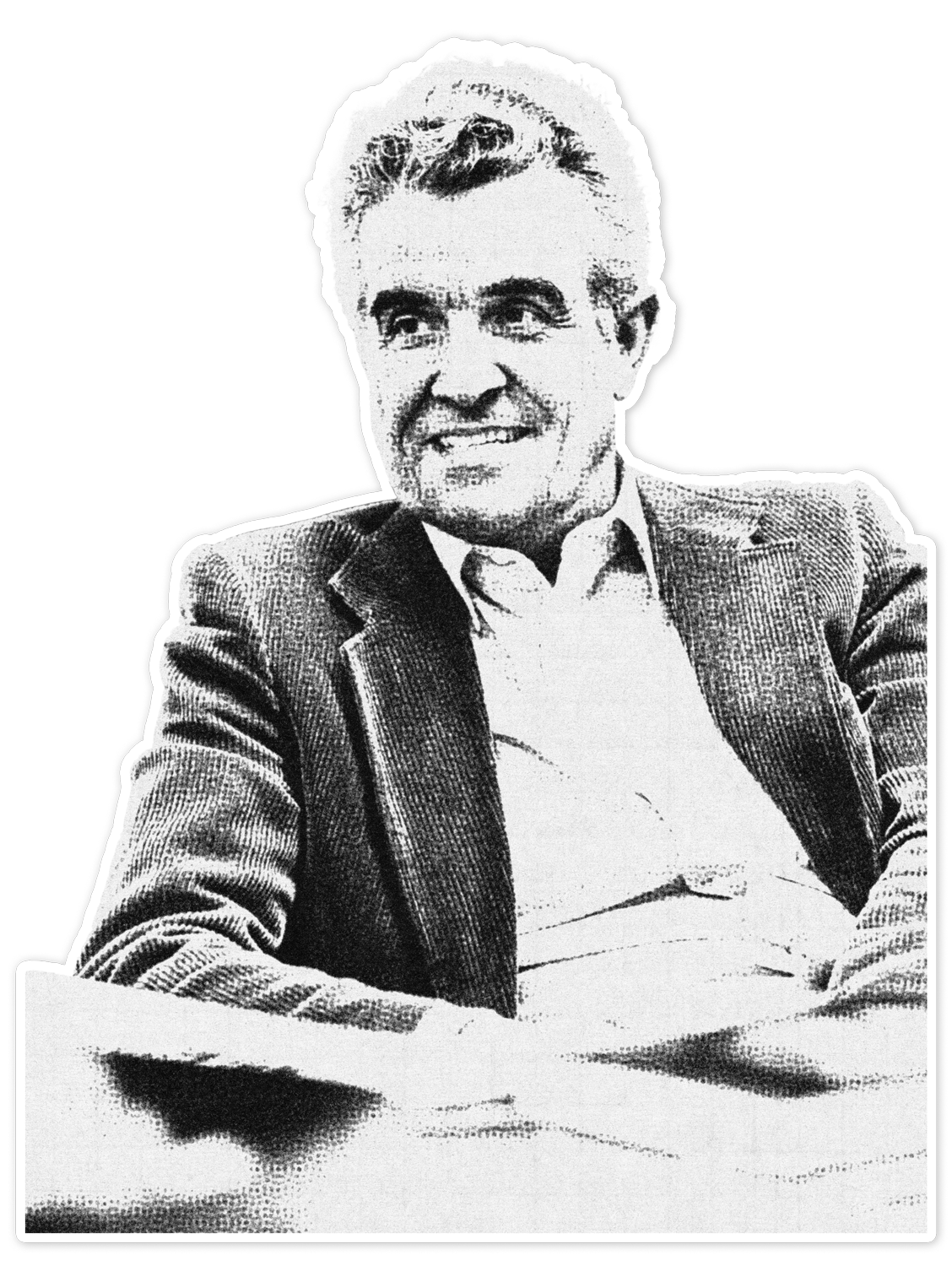

Born in Avignon, France, Girard came of age in a world shadowed by the devastating suffering of World War II. After the war, he moved to the United States, where he taught at several universities before settling at Stanford as a professor of literature.
In studying the world’s great novels — books by writers like Cervantes, Dostoevsky, and Proust — he noticed something surprising. The characters in these novels didn’t simply desire things on their own.
They wanted something
(or someone) they saw
someone else want first.

This insight became the seed
of what is now called
mimetic theory.
(“Mimetic” comes from a Greek
word meaning “to imitate.”)
At its core, mimetic theory
proposes that human desire
is imitative.
We learn what to want through the influence of others. This socially mediated desire can draw us into learning, connection, and creativity — or, when two people desire the same object, rivalry can emerge instead. And because humans are mimetic creatures, rivalry can become contagious, spreading through a community until the relationships fracture and the group dissolves into conflict.
Ancient communities discovered they could restore a sense of unity by concentrating all the conflict on one person or group. By expelling this scapegoat — someone they blamed for their suffering or circumstances — a community could create a cheap facsimile of togetherness. The problem was that this cheap peace never lasted.
Before long, a new conflict
arose and the rivalry and
expulsion began again.
According to Girard, this cycle of imitation, escalating rivalry, and violent scapegoating lies at the very foundation of human culture.
He traced its pattern through literary criticism, history, anthropology, and religion in a series of vivid and influential books including Deceit, Desire and the Novel (1961) and Violence and the Sacred (1972).

Then, after a spiritual conversion experience in his mid 30s, Girard began reading Christian scripture through the lens of his developing theory — and what he found astonished him.
He had previously argued that the world’s ancient myths tell stories from the perspective of the persecutors, portraying victims as guilty.
In the Bible, he saw something different: rather than disguising or justifying the violence of the persecutors, biblical texts gradually revealed the innocence of victims and exposed the pattern of scapegoating for what it was: violence.
This was
groundbreaking.
Girard wasn’t just offering a new angle on literary analysis. He proposed a new way to understand the whole scope of human conflict, religion, and culture.
Today, Girard’s interdisciplinary work influences scholars, theologians, psychologists, entrepreneurs, and peace activists around the world.
His ideas spark lively debate and continue to generate both enthusiasm and critique. In 2005 he was elected to the Académie Française — one of France’s highest scholarly honors.
For many, his theory offers language for something they have sensed but struggled to explain: why conflict spreads so easily, why blame feels so satisfying, and why lasting peace requires more than good intentions.

“In a truly global world, the renunciation of violent reprisal is bound to become, in a more and more obvious way, the indispensable condition of our survival.”
René Girard, The One by Whom Scandal Comes (2014)

At Theology & Peace, we draw on Girard’s insights to help aspiring peacemakers understand these patterns and practice alternatives in everyday life —