

Creating
as a practice of peacemaking
Before we can live peacefully, we have to discover that something other than violence is possible. If contemplation teaches us to slow down and return to awareness, imagination is how we orient our awareness toward those alternative possibilities — and creativity is how we bring what we imagine into being.
Imagination opens us up to possibilities beyond rivalry or exclusion. Creativity helps us experience those alternate possibilities and discern between them.
Imagination contradicts the story that violence is the only way. Mimetic conflict narrows our perception until rivals are reduced to obstacles, caricatures, or threats. Imagination expands our capacity to perceive complexity where scapegoating demands simplification.
It gives us nonviolent models to imitate. Even if you grew up in a tremendously violent environment, you’re not doomed to repeat what you learned. Imagination makes positive loving models available to everyone.
It trains our neural pathways toward what’s possible. In Matthew 19:26 Jesus tells us, “With God, all things are possible.” But how many of us actually feel that, day to day? Creative practice gives us a lived experience that something is always possible, even if it’s not what we originally had in mind.
Practicing creativity with intention & awareness helps protect us from misusing our energy to create violence.
Re-mediating ourselves
through Letters from
Unconditional Love
In recent years, author Elizabeth Gilbert has popularized a practice of imagination & creativity that she calls Letters from Love. The idea is deceptively simple: write a letter, to yourself, from the kindest, most honest, most loving voice you can imagine. If you feel stuck, begin with the question, “Dear Love, what would you have me know today?” Then, sit quietly and write down everything you imagine that kind voice saying in response. See if you can let the words come through you, rather than from you; this is an exercise in perception, not composition.
This practice helps us pay more attention to love so that we recognize it when we encounter it in the world — but it also gives us a Girardian mediator whose gaze trains us toward love instead of toward violence. When we practice greeting our own hurt, scared, or anxious parts with unconditional love, we are actively imitating Christ’s tenderness toward the vulnerable, the outcast, and the impoverished.
Gilbert herself is a living proof that no matter how un-loving the environment was which we inherited, it is possible to re-mediate our brains and behaviors through a more loving gaze even if that gaze is imaginary.
“Learning how to love yourself and speak to yourself kindly is ultimately a public service — not only because you will be less likely to take others emotionally hostage anymore (as I used to do constantly, demanding their care and attention because I could not love myself) but also because you can then broadcast that good, simple love to others, even to those whose names you may never know.”
—Elizabeth Gilbert, Letters from Love
Becca Stevens of Thistle Farms explains the connection between creative arts and healing justice. Thistle Farms is a justice initiative based in Nashville, TN that helps women survivors of trafficking, prostitution, and addiction to heal and build lives of hope and purpose.
Surfacing unconscious desires
and expanding our capacity for
complexity with expressive arts
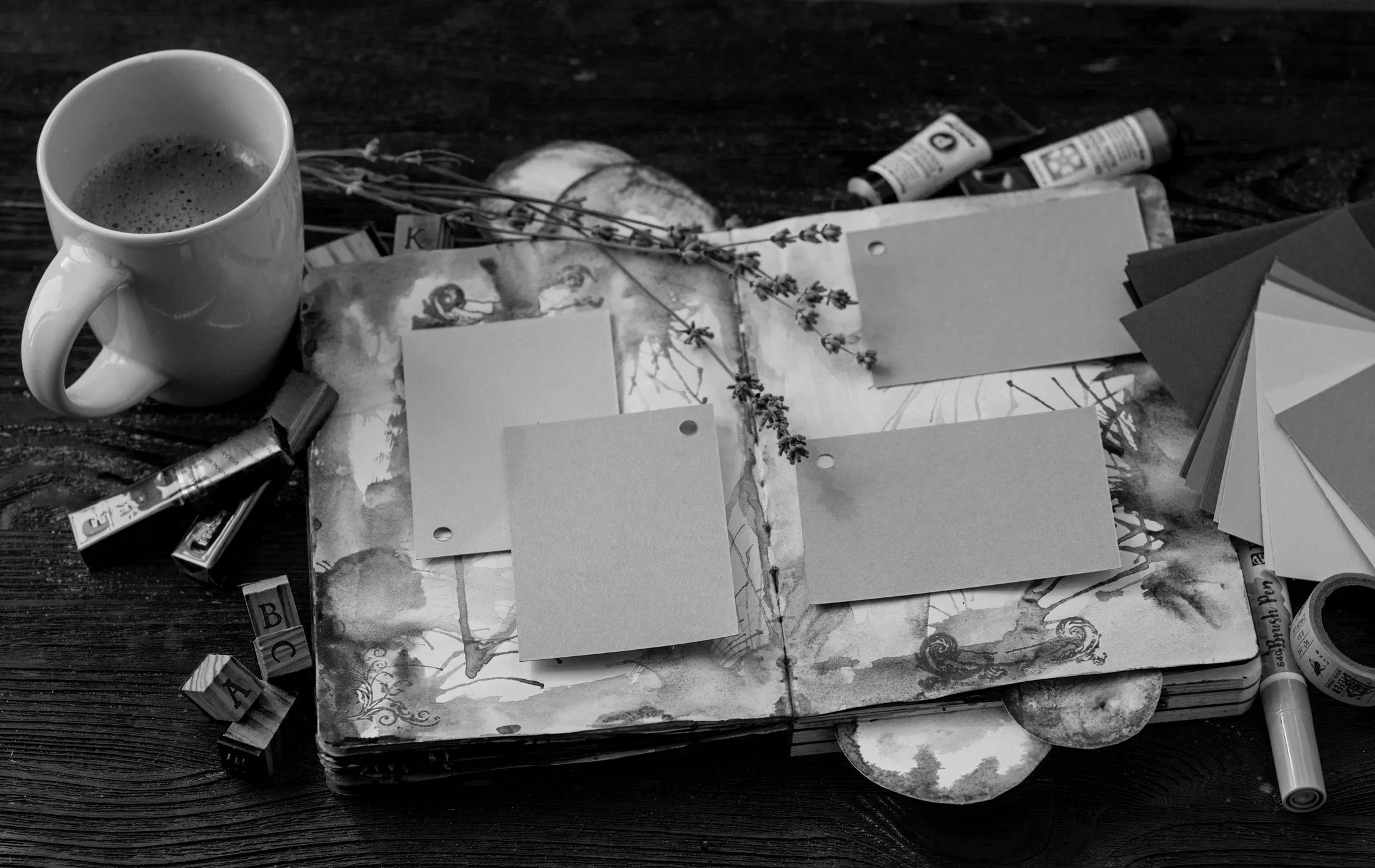
SoulCollage is a practice of expressive arts developed by psychotherapist Seena B. Frost. It involves first the intuitive combining of found images into a small collaged card, and then using the imagination to interpret the meaning of the collage and to speak to ourselves from its unique personality. While you’ll typically find SoulCollage billed as a practice of discovering “inner wisdom”, it has surprisingly profound advantages in the practice of peacemaking too.
SoulCollage expands our capacity for complexity. By encountering the many contradictory figures within ourselves — the ambitious self, the fearful self, the nurturing self, the envious self, the joyful self — SoulCollage trains our body to be able to hold tension, multiplicity, and ambiguity without overpowering or exiling any element. As we learn to hold that complexity inside ourselves, we become increasingly able to hold that complexity socially, too. Over time, that shift makes it more possible to encounter other people with the same posture: not reducing them to the part of them we dislike or fear, but remaining open to the complexity and contribution they bring to communal life.

“We must place our bets on either the total disappearance of the human race or on our arriving at forms of freedom and awareness that we can hardly imagine.”
René Girard