

Understanding The Prophetic in Judaism, Girardian Thinking, and Levinasian Philosophy
I define the prophetic in my book, The Prophetic Law and elsewhere,* as “the recognition of the dramas in which human beings are engaged and the naming in advance of the end of those dramas in order that we might choose to go to those ends or not." As so defined, the prophetic is not about fortune-telling. Nor is it about retrospective confirmation. Rather it is about a method of thinking developed by the Hebrew prophets (Isaiah, Jeremiah, Ezekial, Jonah, and others) and developed further in recent decades among “structuralist" and “poststructuralist" philosophers in France (particularly Rene Girard and influential Jewish Philosopher Emmanual Levinas).
I will talk about the ways in which Girard’s analyses of mimetic desire and “the scapegoat mechanism" and Levinas’s concept of my “infinite responsibility” for the other human being complement each other: Girard leads us to the door of what Levinas calls “the ethical” without ever passing through it; and Levinas, in a way entirely compatible with Girard's analysis of the Sacred, begins at the door of the ethical where Girard leaves off, examining the nature and limits—or lack of limits—of love and responsibility as a response to the other person. Together the two thinkers help and extend one another’s work, providing what is undeveloped in the other.
In the last 15-20 minutes of my presentation time, fellow Girardian and Theology & Peace Board Member Rebecca Adams will pose a few starting questions about how the prophetic can inform our understanding of history and the political upheavals of our own time. We may also touch upon another troubling phenomenon we often see nowadays: Girard's notion of “victimology" and “the other totalitarianism" (as expressed in his I See Satan Fall Like Lightning) in which, in the name of defending the "innocence of the victim," one identifies a new perpetrator and undertakes a new “sacrificial" scapegoat mechanism against that “perpetrator.”
The event will conclude with an additional 30 minutes or more of moderated Q & A from the audience.
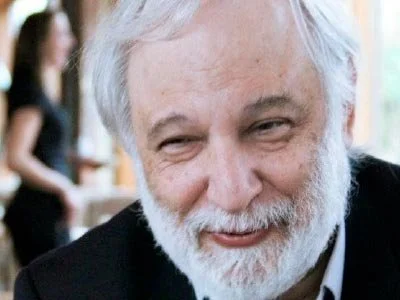
Sandor Goodhart is a Professor Emeritus of English and Jewish Studies at Purdue University in the English Department, and the former Director of the Jewish Studies, Classical Studies, and Religious Studies Programs in the School of Interdisciplinary Studies at Purdue.
He is the author or editor of eight books on literature, philosophy, and Jewish Studies including Desiring Machines: Mimetic Theory and Artificial Intelligence in Technology, Philosophy, Film and Fiction (Bloomsbury Academic Press, 2025; co-edited with Thomas Ryba); Of Levinas and Shakespeare:“To See Another Thus” (Purdue University Press, 2018; co-edited with Moshe Gold); Möbian Nights: Reading Literature and Darkness (Bloomsbury, 2017); The Prophetic Law: Essays in Judaism, Girardianism, Literary Studies, and the Ethical (Michigan State University Press, 2014); Sacrifice, Scripture, and Substitution: Readings in Ancient Judaism and Christianity (Notre Dame University Press, 2011; co-edited with Ann Astell), For René Girard: Essays in Friendship and Truth (Michigan State University Press, 2009; co-edited with James Williams, Thomas Ryba, and Jørgen Jørgensen); Reading Stephen Sondheim: A Collection of Critical Essays (Garland, 2000); and Sacrificing Commentary: Reading the End of Literature (Johns Hopkins University Press, 1996).
He served as guest editor for a special issue of Shofar, 26.4 (Summer 2008) on Emmanuel Levinas, as co-editor (with Monica Osborne) of a special issue of Modern Fiction Studies, 54.1 (Spring 2008) on Emmanuel Levinas, and as editor of a special issue of Religion, An International Journal 37.1 (March 2007) on René Girard. In 2012 and 2013, he co-hosted (with Benoît Chantre) an international conference on Emmanuel Levinas and René Girard (“Du sacré au saint”) at the Bibliothèque Nationale de France and the École Normale Supérieure.
He is a founding board member of the North American Levinas Society (now in its twentieth year), the former President of the Colloquium on Violence and Religion (2004-2007), and the author of over one hundred essays.
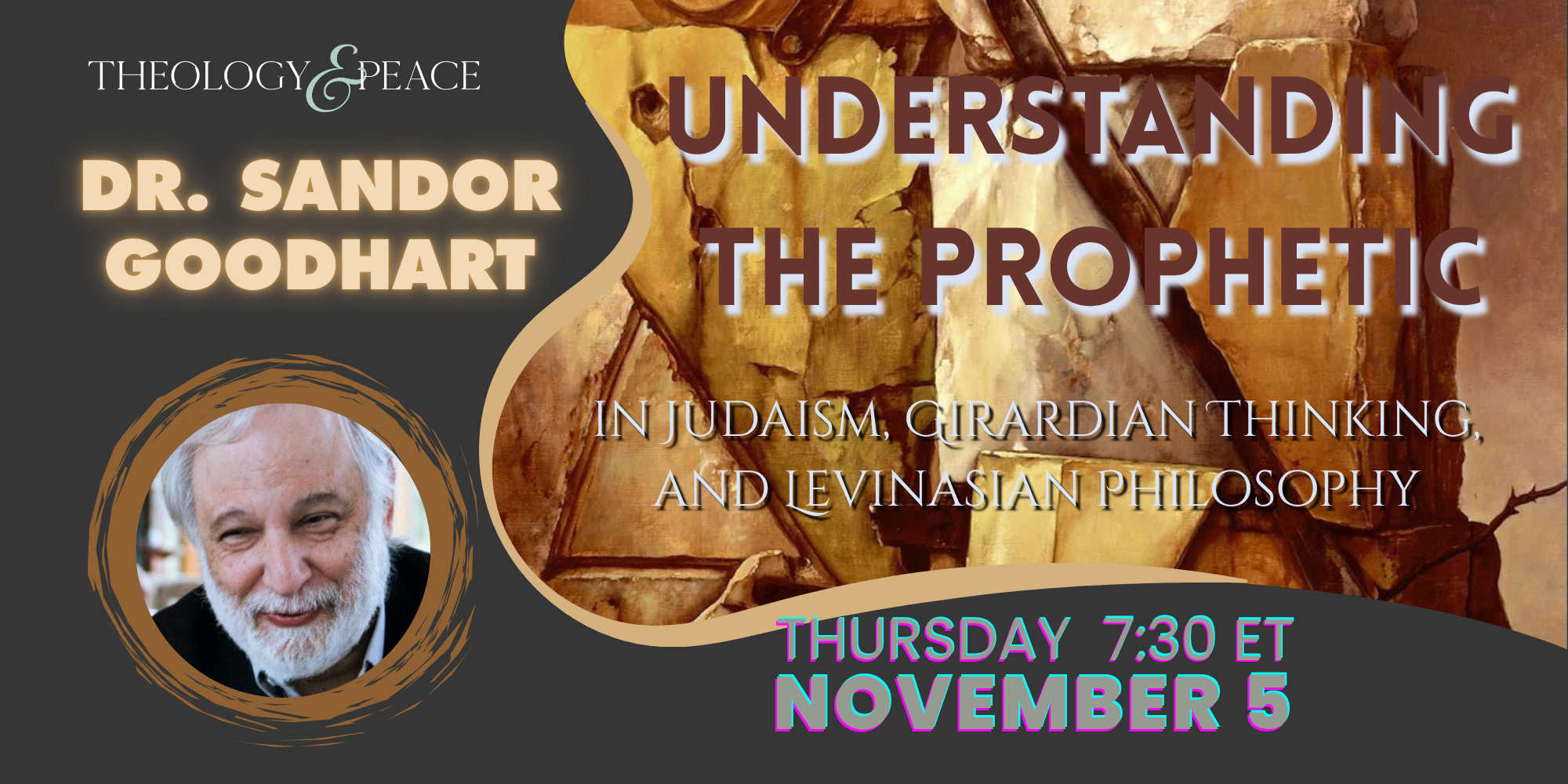
This page uses artwork from Samuel Bak's painting Memorial (Landscape of Jewish History), which is the cover art of Dr. Goodhart's 2014 book The Prophetic Law.